

How to Reconstitute Peptides at Home
This A Step-by-Step Guide
Follow this link to watch detailed video
Reconstitution refers to the process of transforming a freeze-dried (lyophilized) peptide powder into a liquid form suitable for injection. Although the steps are straightforward, maintaining precision and sterility is essential. Errors during this process can compromise the peptide’s effectiveness or, in more serious cases, lead to infection. This guide outlines each stage, from preparing your materials to properly storing the final solution.
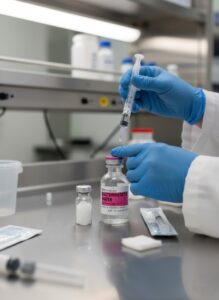
🧪 Understanding the Basics of how to reconstitute peptides at home
Before you begin, it’s important to understand why we reconstitute. Peptides are supplied as a dry powder because they are fragile molecules. In liquid form, they can degrade quickly due to hydrolysis (reaction with water) or bacterial growth. The powder is stable at room temperature until mixed. how to reconstitute peptides at home
Key Terms:
Lyophilized: The freeze-dried powder form.
Bacteriostatic Water (BAC): Sterile water with 0.9% benzyl alcohol. This alcohol prevents bacterial growth, allowing the reconstituted peptide to be stored in a refrigerator for weeks or months.
IU vs. mg: Units of measurement. Insulin syringes measure in “units” (IU). You must calculate the concentration correctly.
🛡️ Safety First & Supplies Needed
Sterility is your top priority. Failure to maintain a sterile environment can lead to infection at the injection site or ruin the vial.
Supplies:
Peptide Vial: The lyophilized powder in a sealed glass vial.
Bacteriostatic Water (BAC): Never use sterile water or saline for multi-dose vials.
Insulin Syringes: 1ml (1cc) syringes with 29-31 gauge needles (0.5 inch or 8mm).
Alcohol Wipes: 70% isopropyl alcohol.
Sterile Gauze: (Optional, for clean-up).
Vial Clamp/Pliers: (Optional, to help hold vials when inserting needles).
The Golden Rule: Wash your hands thoroughly with soap and water before handling any supplies.
📏 Step 1: The Math Calculating Your Dosage
This is the most critical step. If you get the math wrong, you could underdose (wasting expensive product) or overdose (dangerous side effects).
The Formula:
Dosage (in ml)=Desired Dose (in mg)Total mg in Vial×ml of BAC water added
Example:
You have a 5mg vial of BPC-157. You add 2ml of BAC water. You want to draw a 250mcg (0.25mg) dose.
Concentration: 5mg÷2ml=2.5mg per 1ml.
Conversion: 2.5mg=2500mcg.
Dose: To get 250mcg, you need 250mcg÷2500mcg=0.1ml (or 10 units on a standard insulin syringe).
Pro Tip: Use an online peptide calculator to double-check your math, but learn to do it manually to understand your dosage fully.
🧼 Step 2: Preparation & Sanitization
Set up a clean, uncluttered workspace. A kitchen counter is fine if wiped down, but avoid bathrooms where airborne bacteria are prevalent.
Remove Caps: Take the plastic flip-top cap off the peptide vial and the BAC water vial. Do not remove the rubber stopper.
Sanitize: Take an alcohol wipe and thoroughly scrub the rubber stoppers of both the BAC water vial and the peptide vial. Let them air dry for 30 seconds. Do not blow on them to speed this up, as your breath contains bacteria.
💧 Step 3: Reconstituting the Peptide
The goal here is to introduce the liquid gently. If you shoot a jet of water directly onto the powder, the force can break the peptide bonds (denature the peptide), rendering it useless. how to reconstitute peptides at home
Draw the BAC: Take a new, sterile insulin syringe. Remove the needle cap. Pull the plunger back to draw in air equal to the amount of BAC you plan to inject (e.g., 2ml of air). Insert the needle into the BAC vial, push the air in, then invert the vial and draw out the desired amount of BAC water.
Inject Slowly: Insert the needle into the center of the peptide vial’s rubber stopper. Tilt the vial slightly.
The Gentle Technique: Press the plunger slowly so the BAC water trickles down the inside glass wall of the vial. Do not spray directly onto the puck of powder.
Swirl, Don’t Shake: Once all the water is in, remove the needle. Gently roll the vial between your palms or swirl it. Never shake the vial. Shaking creates bubbles and aggressive agitation that can damage the delicate peptide structure.
Dissolution: Within a minute or two, the clear liquid should be free of floating particles. If it is cloudy, the peptide may have been damaged or is of poor quality.
❄️ Step 4: Storage & Handling
Peptides are time-sensitive once reconstituted.
Refrigerate Immediately: Place the vial in the refrigerator (36°F to 46°F / 2°C to 8°C). Do not freeze the liquid peptide.
Light Protection: Ideally, store the vial in a dark container or wrap it in foil, as light can degrade some peptides.
Shelf Life: Generally, a peptide reconstituted with BAC water is considered potent for 30 to 60 days when stored properly in the fridge. Always check the specific peptide’s stability data.
🩹 Step 5: Drawing the Final Dose
When you are ready to administer your dose (usually subcutaneously into the belly fat), you must sanitize again.
Clean: Wipe the top of the peptide vial with a fresh alcohol wipe.
Insert: Use a new, sterile insulin syringe. Push the needle through the center of the stopper.
Invert: Turn the vial upside down. Ensure the needle tip is submerged in the liquid.
Draw: Pull the plunger back to your calculated dosage (e.g., 10 units).
Check for Bubbles: Tap the syringe to move bubbles to the top, then push the plunger slightly to expel them. Do not spray the peptide out; just push until a tiny bead appears at the needle tip. how to reconstitute peptides at home
🗑️ Disposal & Troubleshooting how to reconstitute peptides at home
Sharps Disposal: Used needles must go into an FDA-approved sharps container. Never throw loose needles into the household trash.
Clogged Needle: If the needle seems clogged, do not force it. Draw a small amount of air into the syringe to clear it, or change the needle.
Pain at Injection: If you feel a sting or burn, ensure the alcohol from the wipe has fully dried before injecting. Alcohol on the needle tract causes pain.
Cloudiness: If your reconstituted peptide turns cloudy or has floaters after refrigeration, do not use it. This indicates bacterial contamination or peptide degradation.
✅ Final Checklist of how to reconstitute peptides at home
| Step | Status |
|---|---|
| Math | Dosage calculated and double-checked. |
| Hygiene | Hands washed; workspace clean. |
| Sanitization | Vial stoppers wiped with alcohol and dried. |
| Gentle Mixing | BAC water added down the glass side; vial swirled, not shaken. |
| Storage | Vial placed in the refrigerator immediately after use. |
| New Syringe | A fresh syringe used for every single draw and injection. |
Disclaimer: This guide is intended for informational and educational purposes only. Peptides are research chemicals or prescription-only medications in many jurisdictions. The process described involves medical injections. Always consult with a licensed healthcare provider for medical advice, diagnosis, or treatment. The author assumes no responsibility for improper use, injury, or adverse effects resulting from following these instructions.