tb 500 and bpc 157
Introduction: A Paradigm Shift in Recovery & Regeneration 🚀
Imagine a world where a torn ligament could heal in weeks instead of months. Where a leaky gut could be sealed with precision, not just managed with diet. Where the debilitating wear-and-tear of age or intense training could be actively reversed at a cellular level.
This is not science fiction. It’s the burgeoning reality of peptide therapy, and at its forefront are two extraordinary compounds: BPC-157 and TB-500 (Thymosin Beta-4). Often mentioned in the same breath by biohackers, athletes, and forward-thinking clinicians, these peptides represent a new frontier in regenerative medicine. Yet, they are shrouded in mystery, hype, and a fair share of misinformation.
This comprehensive guide isn’t just another article; it’s your authoritative deep dive into the universe of BPC-157 and TB-500. We will dissect their unique mechanisms, explore their profound synergy, scrutinize the research (both animal and human), and provide a pragmatic, evidence-based framework for their use. Whether you’re a curious enthusiast, a seasoned athlete, or someone battling a chronic injury, this 4000+ word manifesto will equip you with the knowledge to understand these powerful healing agents.
Chapter 1: Meet the Molecules – Origins & Fundamental Biology 🔬 tb 500 and bpc 157
BPC-157: The Guardian of the Gut 🛡️
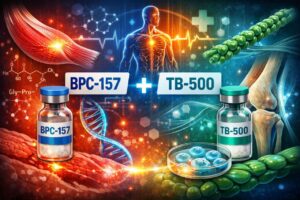
BPC-157 stands for Body Protection Compound-157. It is a synthetic peptide, a sequence of 15 amino acids, derived from a protein found in human gastric juice. This origin story is crucial—it’s literally a part of our body’s own repair kit for the digestive tract.
Nature’s Design: Being a fragment of a naturally occurring protein, BPC-157 is often described as “body-friendly.” It’s not a foreign, alien chemical; it’s a concentrated, optimized version of a signal our body already uses.
Stability Superpower: Unlike many peptides that are fragile and must be handled with extreme care, BPC-157 is remarkably stable. It can survive the acidic environment of the stomach, which is why oral administration is a viable (though debated) route, alongside injections.
TB-500: The Architect of Cellular Movement 🏗️
TB-500 is the researched analogue of Thymosin Beta-4, a naturally occurring peptide present in virtually all human and animal cells, with high concentrations in blood platelets, wound fluid, and healing tissues.
The Master Regulator: TB-500 isn’t just a building block; it’s a master conductor. Its primary role is to orchestrate cell motility—the movement and migration of cells. It’s the signal that tells repair cells, “Go here, now, and start rebuilding.”
Systemic vs. Local: While BPC-157 has strong local and systemic effects, TB-500 is renowned for its powerful systemic (whole-body) impact. It promotes healing far from the site of administration by traveling through the bloodstream, signaling repair processes wherever they are needed.
Chapter 2: Mechanisms of Action – How They Work Their Magic 🧙♂️
Understanding how these peptides work separates the facts from the fanfare. Their mechanisms are distinct yet beautifully complementary.
BPC-157’s Multi-Target Healing Toolkit 🧰
Angiogenesis Promotion: It significantly increases the formation of new blood vessels (angiogenesis). No blood supply, no healing. By boosting blood flow to injured areas, it delivers oxygen, nutrients, and repair cells.
Growth Factor Upregulation: It stimulates the production of key growth factors like VEGF (vascular endothelial growth factor) and FGF (fibroblast growth factor), turning up the volume on the body’s innate repair signals.
Tendon & Ligament Specificity: It uniquely promotes the outgrowth of tendon fibroblasts and the synthesis of collagen type I, the primary structural protein in tendons and ligaments. This makes it exceptionally targeted for musculoskeletal injuries.
Anti-Inflammatory & Cytoprotective Actions: It modulates the inflammatory response, reducing excessive inflammation while protecting cells (cytoprotection) from various toxins and stressors, even in organs like the liver and brain.
Gut Healing Prowess: It accelerates the healing of ulcers, protects against NSAID-induced damage, and can help normalize gut motility—demonstrating its “guardian of the gut” role.
TB-500’s Mastery of Cellular Dynamics 🧫
Actin Regulation – The Mobility Engine: Actin is the protein that forms the cellular “skeleton” and enables movement. TB-500 binds to actin, promoting cell migration, proliferation, and differentiation. Healing requires cells to move to the damage site; TB-500 makes that happen efficiently.
Anti-Inflammatory Signaling: It downregulates key inflammatory cytokines (like IL-1β, TNF-α), reducing the destructive inflammatory phase of injury and shifting the process toward clean-up and rebuild.
Keratinocyte Migration: This is critical for skin wound healing, as it speeds up the movement of these outer-layer skin cells to close a wound.
Blood Vessel & Neural Outgrowth: Like BPC-157, it promotes angiogenesis. It also encourages neurogenesis (growth of new neurons) and synaptogenesis (formation of neural connections), hinting at benefits for nerve repair and cognitive function.
Chapter 3: The Research Landscape – From Animal Studies to Anecdotal Triumphs 📊 tb 500 and bpc 157
The Promising Pre-Clinical Data (Animal Studies) 🐁
The volume of animal research on these peptides is substantial and consistently positive.
BPC-157 Studies Show:
Tendon Healing: Complete transection of the Achilles tendon in rats heals functionally and structurally when treated with BPC-157, matching the strength of an uninjured tendon.
Gut Repair: Effective against various models of colitis, ulcers, and fistula.
Organ Protection: Demonstrated protective effects on the liver, brain, and heart under stress.
Bone & Joint Healing: Accelerated healing of bone defects and improved recovery from traumatic joint injuries.
TB-500 Studies Show:
Cardiac Repair: Improved recovery and reduced scarring after heart attacks in mice.
Skin & Eye Wounds: Dramatically accelerated closure of corneal and dermal wounds.
Muscle Regeneration: Enhanced repair of skeletal muscle injuries.
The Elephant in the Room: Yes, nearly all this data is from animals. Human clinical trials are limited and often small-scale or proprietary. This is the current gap where anecdotal evidence and clinical experience have filled the void while we await larger-scale human trials.
The Mountain of Anecdotal & Clinical Experience 🗻
Despite the lack of large human trials, the anecdotal reports from athletes, veterans, and patients with chronic conditions are overwhelming and specific. This “n=1” evidence, while not scientifically conclusive, forms a compelling pattern:
Chronic Tendinopathies (tennis elbow, Achilles tendinosis) that resisted years of therapy reportedly resolving in weeks.
Post-Surgical Recovery (ACL reconstruction, rotator cuff repair) being drastically accelerated.
Gut Disorders (IBS, leaky gut, Crohn’s) experiencing significant symptomatic relief.
Stubborn Ligament Sprains (ankle, knee) finally healing.
Chapter 4: BPC-157 vs. TB-500 – The Synergistic Duo, Not Competitors 🤝
This is a critical distinction. They are not interchangeable; they are synergistic partners that work best together for comprehensive healing.
| Aspect | BPC-157 (The Local Guardian) | TB-500 (The Systemic Conductor) | Synergy in Action |
|---|---|---|---|
| Primary Role | Tissue-specific repair & protection. Promotes blood flow, collagen, growth factors. | Cellular movement & organization. Directs cell migration and reduces inflammation. | TB-500 mobilizes repair cells and gets them to the site. BPC-157 then provides the ideal local environment for them to do their work effectively. |
| Best For | Localized injuries: Tendons, ligaments, joints, gut lining, localized inflammation. | Systemic/diffuse issues: Muscle tears, widespread inflammation, recovery from systemic stress, skin wounds. | A major musculoskeletal injury (e.g., torn rotator cuff). TB-500 systemically signals repair. BPC-157 locally rebuilds tendon-bone connection. |
| Mechanistic Focus | Angiogenesis, Growth Factors, Cytoprotection. | Cell Motility (Actin), Anti-inflammatory. | Covers the entire healing cascade: from cell signaling and migration to tissue construction and protection. |
The Healing Orchestra Analogy: Think of an injury site as a construction zone. TB-500 is the foreman and logistics manager. It calls in the workers (repair cells), gets them to the right location, and manages the overall work schedule. BPC-157 is the site supervisor and materials supplier. It ensures the site has power and water (blood flow), delivers concrete and steel (collagen, growth factors), and protects the site from rain (excessive inflammation). You need both for an efficient, high-quality rebuild.
Chapter 5: Practical Application – Protocols, Administration, & Cycling 🩹💉
⚠️ CRITICAL DISCLAIMER: This is for informational purposes only. Peptides are potent research chemicals. You must consult with a licensed healthcare professional experienced in peptide therapy before considering use. ⚠️
Sourcing & Purity 🧪
The #1 Rule: Source from reputable, FDA-registered compounding pharmacies (with a prescription) or highly vetted research chemical companies that provide independent, third-party Certificate of Analysis (COA) for purity and volume.
Form: They are typically sold as lyophilized (freeze-dried) powder in sterile vials.
Reconstitution & Storage 🧊
Bacteriostatic Water is the standard diluent.
Math is Essential: Calculate your desired dose accurately based on vial size and added water volume.
Storage: Once reconstituted, keep refrigerated (2-8°C) and use within a few weeks. Unreconstituted vials can be stored in a cool, dark place or refrigerated.
Administration Routes 🗺️
Subcutaneous (SubQ) Injection: The gold standard for systemic and reliable effects. Administered into the fat layer (e.g., abdomen). For localized injuries, “sub-Q near the site” is common for BPC-157.
Intramuscular (IM) Injection near Injury: Sometimes used for very localized targeting (e.g., a shoulder injury), though debate exists on true localized vs. systemic effect.
Oral (BPC-157 only): For gut-specific issues, oral capsules (often in an enteric-coated, stable form) are popular. Bioavailability is lower, so doses are typically higher.
Sample Protocols (For Educational Illustration)
Acute Tendon Injury (e.g., Severe Tennis Elbow):
Weeks 1-6: BPC-157: 250-300 mcg, twice daily (SubQ near elbow). TB-500: 2-2.5 mg, twice per week (SubQ).
Weeks 7-12: BPC-157: 250 mcg once daily. TB-500: 2.5 mg once per week. Monitor healing.
Systemic Recovery & Gut Repair:
Weeks 1-8: BPC-157 (Oral): 500-1000 mcg per day on empty stomach. TB-500: 2.5 mg, twice per week (SubQ).
Cycling: Typical cycles run 8-12 weeks, followed by a break of 4-8 weeks to prevent receptor desensitization and allow the body’s own systems to resume command.
Chapter 6: Potential Side Effects & The Unknowns ⚠️🔮 tb 500 and bpc 157
No bioactive substance is without potential effects.
BPC-157: Remarkably well-tolerated in reports. Some note mild, transient headaches or lightheadedness, especially at higher initial doses. Its strong angiogenic properties raise theoretical concerns about stimulating pre-existing conditions.
TB-500: Similarly well-tolerated. Due to its systemic nature, some report mild fatigue as the body redirects energy toward repair.
The Big Unknowns:
Long-Term Effects: Decades of human data do not exist.
Cancer Risk: The theoretical concern is that promoting angiogenesis and cell growth could feed pre-existing, undiagnosed micro-tumors. There is no evidence it causes cancer, but the prudence is to avoid if you have a personal history.
Hormonal & Endocrine Effects: Current data suggests they are not hormonally active, but full-spectrum long-term studies are lacking.
Contraindications: Pregnancy, breastfeeding, active cancer, or a history of malignant cancers.
Chapter 7: The Legal & Ethical Gray Zone ⚖️
Legal Status: In many countries (like the USA), BPC-157 and TB-500 are not FDA-approved for human treatment. They are sold as “research chemicals” or “for laboratory use only.” However, they are not classified as controlled substances (like steroids). Doctors can legally prescribe them as compounded medications, which is a legal loophole that allows for clinical use.
Athletic Bans: TB-500 is explicitly banned by WADA (World Anti-Doping Agency) as a hormone and metabolic modulator. BPC-157 is not currently on the WADA prohibited list, but its status is ambiguous and athletes should exercise extreme caution. Its performance-enabling (via recovery) effects could still be considered a violation of the spirit of the rules.
Chapter 8: The Future of Peptide Healing & Final Thoughts 🌅 tb 500 and bpc 157
We are standing at the dawn of the peptide revolution. BPC-157 and TB-500 are the vanguard. As research progresses, we can expect:
More refined, targeted peptide sequences.
Improved delivery methods (patches, nasal sprays).
Larger-scale human clinical trials.
Integration with other regenerative modalities (PRP, stem cells).
Final Verdict:
BPC-157 and TB-500 are arguably the most powerful and accessible healing tools to emerge in decades. They are not magic bullets, but they are powerful signal enhancers that dramatically optimize the body’s innate capacity for repair. They work best within a holistic framework: a nutrient-dense diet, quality sleep, sensible training, and stress management.
For the individual suffering from a chronic, debilitating injury or condition that conventional medicine has failed to resolve, these peptides offer a beacon of hope backed by compelling mechanistic science and a torrent of positive real-world experience. The path forward is one of cautious optimism, rigorous self-education, and professional guidance.
The future of healing is not just about managing symptoms it’s about commanding your biology to regenerate. BPC-157 and TB-500 are your first, potent conversation with that future.
🔬 Resources for the Curious Mind:
🙏 Acknowledgments to the Pioneers: The brave clinicians and researchers who are pushing this field forward through clinical practice and advocacy, often against institutional inertia.
The information contained in this blog post is for educational and informational purposes only and is not intended as health or medical advice. Always consult a physician or other qualified health provider regarding any questions you may have about a medical condition or health objectives.